Strategy graveyard #3 — and this one is a mass grave. Over one month we simulated 17 different daily-ticket configurations on our own settled predictions: one to six legs per ticket, three selection methods (market favourites, an odds-band filter, and our own value signals), all priced at real Betfair exchange odds with 2% commission, 10 lei per daily ticket. Then we did the thing no tipster ever does: we audited every result for luck.
The headline table
| Legs | Selection | Result | Expected (EV) | P(luck) |
|---|---|---|---|---|
| 5 | favourites | +116% | −27% | 0.8% |
| 5 | odds 1.70–2.00 | +205% | −23% | 3.6% |
| 3 | favourites | +28% | −17% | 4.7% |
| 2 | value signals | +46% | −1.3% | 12.1% |
| 4 | value signals | −59% | −6% | 51% |
| 6 | favourites | −8% | −33% | 28% |
| 5 | "top skill leagues" | −100% | −42% | — |
Fourteen of the seventeen configurations finished the month in profit. Every single one had negative expected value. That contradiction is the entire accumulator industry in one table.
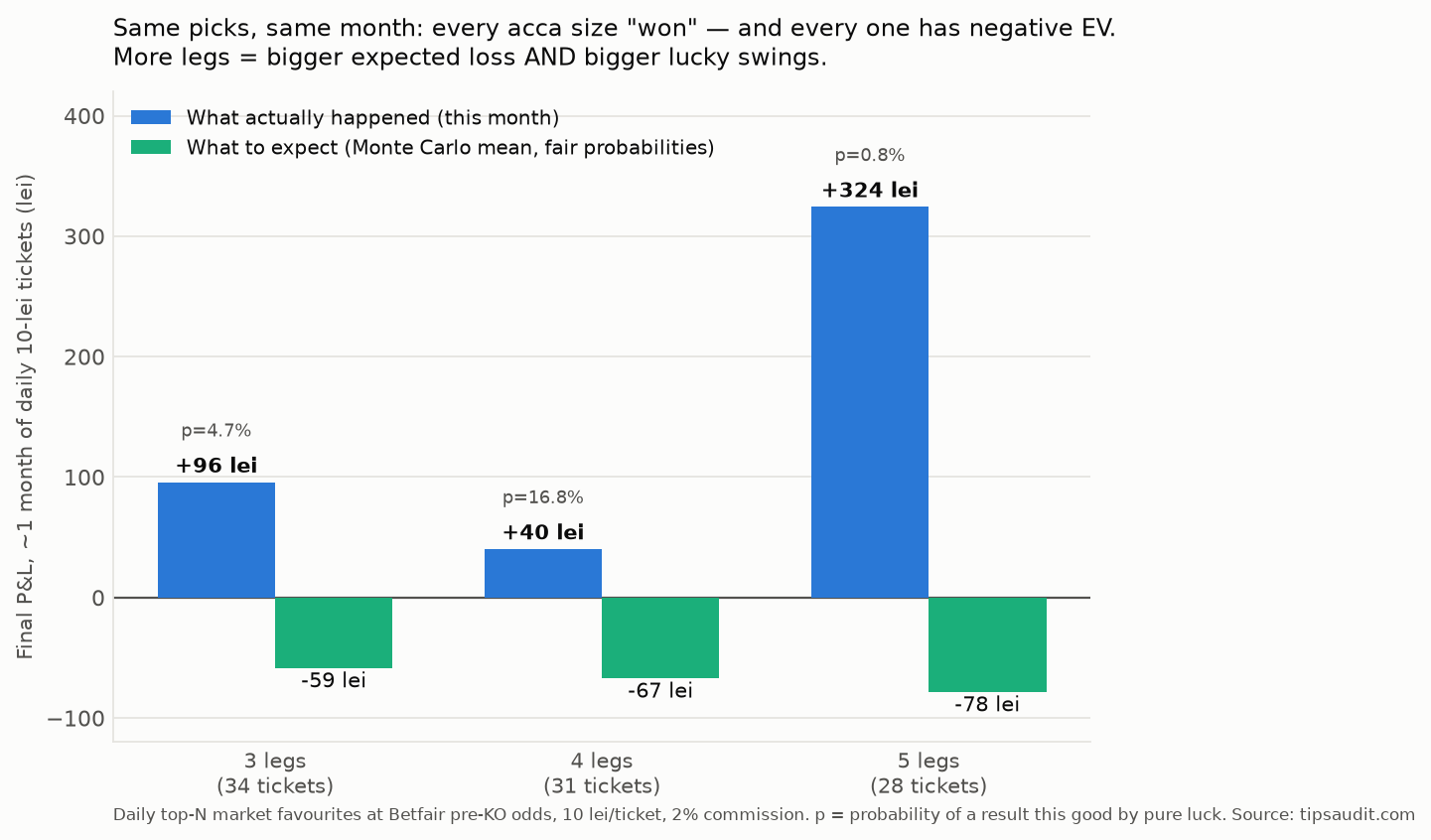
Finding 1: the tax ladder is real and almost perfectly linear
The expected loss per ticket, as a share of stake, by number of legs — measured, not theorised:
| Legs | 1 | 2 | 3 | 4 | 5 | 6 |
|---|---|---|---|---|---|---|
| EV | −6.5% | −12.7% | −17.2% | −22.0% | −27.4% | −33.1% |
Every leg you add costs roughly 5–6 percentage points of your stake. This is the compounding-margin arithmetic from our accumulator article, now confirmed on 1,500+ lei of simulated stakes at real exchange prices.
Finding 2: one lucky month wears seventeen costumes
Why did 14 of 17 configurations profit despite negative EV? Because they all drew from the same pool during the same month — and that month was freakishly kind. The heaviest daily favourites hit 89.5% against a fair expectation of 73.2%: a 1-in-333 run (p=0.3%). Every ticket format simply amplified that one anomaly, and the longer the ticket, the more spectacular the amplification: +18% at one leg became +116% at five.
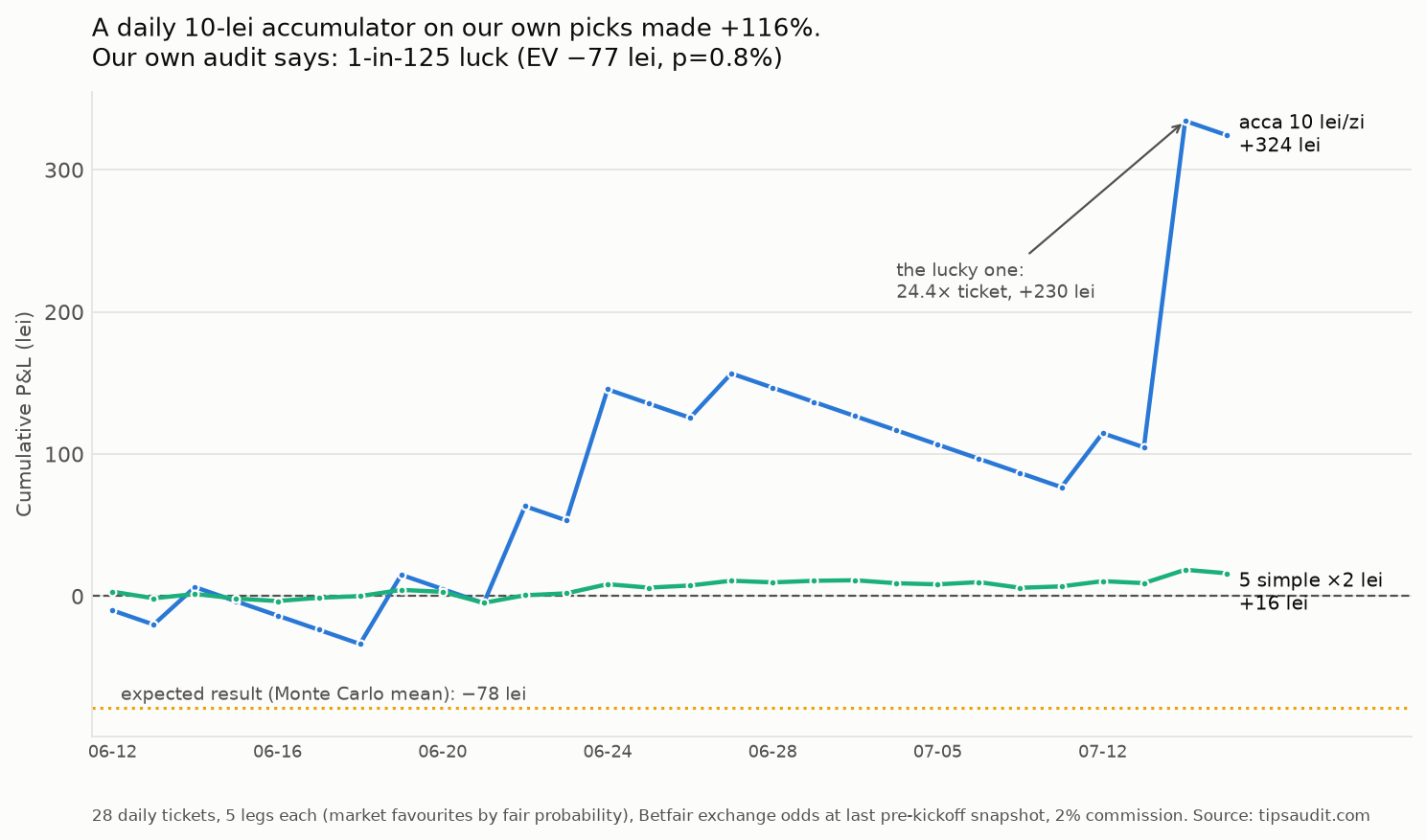
The 5-leg flagship made +324 lei — and 71% of that came from a single 24.4× ticket. Our Monte Carlo audit (20,000 replays at fair probabilities): expected result −78 lei, probability of doing this well by pure chance 0.8%. If a tipster showed you this month as proof, our own audit tool would grade it F. We graded ourselves the same way.
Finding 3: the "odds sweet spot" is folklore
The beloved 1.70–2.00 band produced +205% on 5-leg tickets. Then we moved the filter to 1.50–2.00 at 2 legs: −29%. Singles on the same picks: ±0% both times. A "system" whose sign flips when you nudge a filter by 0.20 is not a system — it is a random number generator with a subscription fee.
Finding 4: even a real edge dies inside a parlay
Our value signals are the one selection method with a genuine, measured edge (positive CLV in 10 of 10 leagues). As singles at Betfair prices they returned +11% to +18% in every configuration tested. Bundled into 5-leg tickets, the same signals swung between +24% and −59% — pure noise, because a 2% average win probability per ticket turns any edge into a lottery. The accumulator does not multiply your edge. It multiplies your variance until the edge is invisible.
Finding 5: the cherry-pick self-destructs
For the finale we did what every punter does after a good month: took our five best-performing leagues and bet only those. Result: 0 wins from 16 tickets, −100%, every leu gone — and even the singles control went negative on that slice. Skill measured on a subgroup of a small sample does not transfer. It is not skill; it is residue.
What survives
One configuration was consistently profitable across the entire study: value signals, played as singles, flat stakes, all leagues — which is, to the letter, the methodology this site publishes every day. Everything else was either a tax (favourites accas), a coin flip (value accas), or a mirage (filters and league-picking).
Every number above is reproducible from our public data. The full staking question — how much to bet on the one thing that works — got its own study: Kelly, tested on 152 real bets.